Leak action request or data in transit
Definition
An unauthorised entity gains knowledge of at least part of an action request or data element exchanged between two other entities.
Context
An action request or data element is transmitted over an uncontrolled channel.
Attacker capabilities
- The attacker can observe (part of) the channel over which the action request or data element is exchanged.
Explanation
An attacker is able to observe the contents of an action request or data element that is exchanged between a requesting and receiving entity. Consequently this attacker can learn, possibly sensitive, information about the actions the sender can request from the receiver and learn sensitive information contained in the exchanged data. For example, an attacker could observe action requests containing payment information when a customer purchases items from an online store or an attacker could observe a user's password that is provided as argument to a login action.
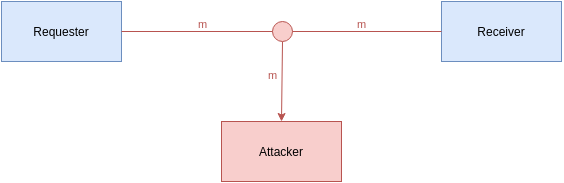
This problem is included in:
- A02: Cryptographic Failures in the OWASP Top 10
Examples
- An attacker obtains intercepts a customer's payment information, e.g. credit card number and CSV code, while that customer makes a purchase. The attacker might profit by selling this information or perform its own purchasing and having the customer pay for it.
- An attacker captures a request from a legitimate user and resends this same request some time later, e.g. replay a login request from a legitimate user to impersonate him or her.
- An attacker observes which actions different users perform and identifies which are privileged users and are interesting targets for more precise attacks.
Possible solutions
- Selective encrypted transmission allows to encrypt certain parts of the action request or data element, e.g. sensitive arguments.
- Encrypted tunnel allows to encrypt the action request or data element as a whole.